


Dear readers:
I’m back in the United States, for now, and so will no longer be updating this blog regularly, though I may still occasionally post news or stories about Sweet Salone.
I will leave this blog up as a resource for those who want to learn more about Sierra Leone – through the eyes of a newcomer in 2006 and a not-so-newcomer in 2010. If you’d like more current news and updates, check out Visit Sierra Leone's blog or sign up for their newsletter. Please also visit the Welbodi Partnership, a deserving effort to improve child health in Sierra Leone.
For those of you who have been following this blog over the years, thanks for reading and for your patience with my infrequent posts. I hope you’ve come to develop a soft spot for sweet, striving, startling, spectacular Sierra Leone.
And if you’d like to join me in a short trip through memory lane, look back through the archives from the last few years, and find:
stories of dust and rain...
of lazy Sundays and hectic Fridays...
of a broken health system and young lives lost and saved ...
of poverty and presidential inaugurations ...
of football stadiums and tiny village cinemas...
of mountains and tiny villages and urban chaos ...
of optimism and giving credit where credit is due...
and so much more.
Sierra Leone is still a deeply poor country, but it is not the same country it was in 2006, when UN forces kept the peace and the lights were out across the capital. With any luck, it will celebrate its 50th birthday next year with an unprecedented – and deserved – sense of hope and possibility.
Maybe you should even go celebrate with them. As a recent article in the UK’s Independent newspaper notes, “wildlife, white sands, and a new wisdom” await you.
For now, kushe and tenki.
Ryann
Sunday, November 07, 2010


Monday, July 26, 2010
Help kids in Sierra Leone without leaving your seat
Rebecca and Welbodi are in the finals and it’s up to the public to choose the winners – so we need your votes NOW! It takes just 60 seconds and could make a big difference to our work supporting pediatric healthcare in Sierra Leone.
The competition ends on Wednesday 28th July 2010, so just a few days left!
What can you do to help?
FIRST: Vote online for Rebecca Cridford through Facebook. Voting closes on Wednesday 28th July 2010.
THEN: Tell everyone you know to vote as well. Post a link in your status. Message all your friends on Facebook. Tweet or blog about us. Email your friends, family, colleagues. Forward to any listservs or groups you belong to. We have just until noon on Wednesday 28th July 2010 to get as many votes as possible.
WANT TO DO MORE?: Contact friends who have blogs or who tweet or facebook frequently and ask them to help spread the word. Ask your school or workplace if you can set up a virtual “voting booth” at lunchtime -- all you need is a connected computer. Call your local radio or write a letter to your local paper to encourage others to vote.
Just a few moments of your time can make all the difference.
Read more below about the Vodafone World of Difference contest, the Welbodi Partnership, and our work at the Ola During Children’s Hospital.
Who is Rebecca Cridford?
Becky Cridford is a UK trained nurse with 7 years of experience in the NHS and overseas. She plans to spend a year working with the Welbodi Partnership at the Ola During Children’s Hospital to support the nursing team to further develop the life-saving skills they need, and to put them into practice. Becky applied to the Vodafone World of Difference programme and was chosen out of over 2,500 applicants to go forward to a public vote on Facebook.
What is the Vodafone World of Difference International programme?
Each year, the Vodafone Foundation supports a handful of inspiring people to work for a year with their “dream charity,” while also providing funds and publicity to those winning charities. More than 2,500 people applied this year for just 8 spots, and it’s now down to a public vote to decide which of 4 candidates will win one of 2 remaining spots! The competition closes
Vote now for Becky and the Welbodi Partnership
What happens if Rebecca wins?
The Vodafone Foundation will provide funding for Rebecca’s year volunteering in Sierra Leone. Vodafone will also make a sizeable donation to the Welbodi Partnership, and we will also benefit from significant free publicity in the UK and elsewhere.
Why do we need support for nursing in Sierra Leone?
Nurses are absolutely vital to save the lives of children in Sierra Leone. The Welbodi Partnership is working to support nurses at the Ola During Children’s Hospital in Freetown in various ways, including in-service training, support to nurse managers to improve supervision, and provision of essential equipment and supplies that help nurses to do their jobs better.
One in four children in Sierra Leone die before they are 5 years old (UNICEF, 2009). There is only one government children's hospital in Sierra Leone, which also serves as a training facility for doctors and nurses. The Free Health Care Initiative launched on the 27th of April this year, which made essential health services free to all pregnant women and children under five, was a wonderful step to improve access but has also resulted in a quadrupling of patient numbers. This puts an added burden on the hardworking nurses and doctors at Ola During.
What is the Welbodi Partnership doing to help?
The Welbodi Partnership’s volunteers work in the Ola During Children’s Hospital to provide on-the-ground training and support to the nurses, doctors, and non-medical staff of the hospital, to improve the quality of care and transform Ola During into a center of excellence for training the next generation of pediatric health workers. To learn more, visit www.welbodipartnership.org .
Vote now on Facebook to help Rebecca Cridford and the Welbodi Partnership win support from Vodafone.
Wednesday, July 21, 2010
Things I don't expect in Sierra Leone: Public safety messages
Today I got a text message from the Sierra Leone Police.
“Please WEAR your seatbelts and safety helmets at ALL times when driving vehicles and motorcycles. Message brought to you from the Police Services Board.”
Mom would be proud.
“Please WEAR your seatbelts and safety helmets at ALL times when driving vehicles and motorcycles. Message brought to you from the Police Services Board.”
Mom would be proud.
Monday, July 19, 2010
The best salesman
Three boys are standing outside the Total station in Wilberforce. One is selling change to my taxi driver. Another is trying to sell cold water in printed sachets. A third is pitching bags of popcorn. They’re all around 8-10 years old.
The popcorn seller, a head taller than the others and obviously the boldest of the bunch, entertains his friends with a tongue-in-cheek sales pitch. “I’m the best salesman,” he says in Krio, “buy from me.” The other boys giggle. “If you buy one, I’ll give you one. If you buy 5, I’ll give you 5.” He grins, infinitely pleased with himself.
“If you buy 25, I’ll give you 25. That’s why I’m the best.”
Laughter all around.
Thursday, July 15, 2010
Snapshots of Freetown 2: Sani Abacha Street
As you reach the end of Kissy Road and pass the clock tower at Eastern Police Station, heading West towards the center of town, Sani Abacha Street slopes down in front of you and then up again, affording a clear view of what is to come. Chaos.

A mass of pedestrians swell and surge around vendors and wheelbarrows and poda-podas and massive trucks, the latter discharging their contents in a stream of speed-walking laborers or inching through crowds spewing toxic fumes. From above, it’s impossible to see even the smallest patch of open pavement. The street is a writhing mass of motion, both human and machine.
You take a deep breath and start your descent into this ocean of people and sounds. Horns blare as vehicles plow through the crowds, scattering pedestrians and, sometimes, vendors themselves – their wares, spread on flattened cardboard or nylon sacks on the ground or piled on makeshift wooden tables, hastily pulled back towards the curb.When two trucks meet, they scrape by one another by mere centimeters, squeezing all foot-bound souls into tiny spaces between the roadside vendors, onto the treacherous sidewalks, or into filthy gutters.

Next in size to the trucks and poda-podas, and often much faster, are dozens of wheelbarrows, omalankes, and other hand-drawn carts. The bare-chested men and boys who drag these, piled high with anything from scrap metal or building materials to cases of beer and soda, are among the hardest-working people in this bustling commercial area. Sweating buckets in the tropical heat, their chests and backs rippling with muscles that gym-heads in the US would kill for, they drag their heavy carts over potholed and unbelievably crowded roads. When they start to pick up momentum, they are loathe to slow down – and hence their urgent shouts join the din, calling out a guttural “hup hup” to anyone in their path, followed by more explicit and angrier commands to those who don’t catch on. Hesitate for a second and these carts, like the trucks and poda-podas, will run you down.
And then, from all directions, come the shouts of hundreds of vendors, pitching their wares at full voice and in an endless carnival-style repetition. Their Krio phrases run together in an often unintelligible stream, this already minimalist language abbreviated further to enable rapid-fire sales pitches. Often, only the prices emerge clearly from the din.
“Buy biscuits 2 for 1-5”.
“You don buy chocolate 1 block.”
“Umbrella 10-10 thousand.”
“Halfback 5 thousand.”
“Grafton 2 block.”
“Kola 1 block.”
“Buy 3 thousand.”
“You don buy?”
“2-2 thousand.”
“1 thousand.”
“5 block.”
And on and on.
The wares are more varied than you could imagine, and you wonder if there is anything you couldn’t find on this street. A mountain of radios to one side. A precarious tower of pots and pans to the other. A tray of chintzy gold jewelry atop a makeshift wooden stool. Familiar breakfast cereals – Corn Flakes, Rice Krispies, Raisin Bran – are sold in slightly battered boxes, as though they were carried across the ocean in giant container ships. (Which they probably were.) Vast assortments of personal hygiene products also include familiar names – Irish Spring soap, Colgate toothpaste, Head and Shoulders shampoo – alongside Arab brands and cheap Chinese knock-offs. You see a glamorous array of perfume bottles and wonder how the 90-degree heat affects their scents.
Many, if not most, of these stalls are run by women, and behind and among the displays are a smattering of young children: babies set on the ground, watching the crowds with wide eyes; toddlers wandering amongst the passersby and playing near the open gutters; slightly older children, some in school uniforms, helping to mind their younger siblings. If forced to the crowded sidewalk by vehicles or the crush of people on the street, you pick your way carefully with your eyes firmly on the ground, hoping you’ll neither step on these children nor fall through the large gaps in the sidewalk where cement slabs are broken or missing.
One of the most common items for sale is fabric, and you see stack after stack of brightly-colored fabrics: printed cotton, embroidered lace, hand-died gara, metallic shine-shine, textured brillante, sequined chiffon. These lengths of fabric, sold by the yard or by “lapa” (a two-yard length suitable for a sarong-style skirt), are stacked on tables, spread artistically at street level, or rolled and stuck into large plastic bins like the spines of giant multi-colored sea anemone.
Fabric sellers are almost always women, and rarely shout. Fruit and vegetable sellers, also women, are constantly shouting. Okra. Cucumbers. Tomatoes. Onions (“yerbas” in Krio). Avocado (“butter pear”) larger than you’ve ever seen. Bananas. Pawpaw. Mangos in mountainous stacks, the smallest smooth-skinned and fist-sized in uniform green or yellow; the largest a mottled reddish-green too large to hold in one hand. Large plastic tubs packed with oversized bunches of cassava leaves and potato leaves adorn the ground. Similar tubs are filled with gari (ground cassava flour), rice, or caustic soda.
As you draw closer to the end of Sani Abacha street, near the area known as PZ, the street widens slightly. The vendors have more space to move, and a few actual shops – as in brick-and-mortar buildings – blare Sierra Leonean pop music from their open doors.
To your right, a young woman shakes a plastic basket filled with cheap metal silverware, the jangling ringing out above the pandemonium around her. “5-5 block,” she shouts.
Ahead of you, a young man blows on some newfangled and deafening noisemaker meant to imitate the howls of a very unhappy baby. People turn to watch and laugh, ignoring the approaching traffic. An impatient truck driver blares his horn, hardly slowly as he drives the crowds out of the way.
Taxis, absent from Sani Abacha, meet you in force when you reach the PZ intersection, and you are forced again to the sidewalk. Your ears are ringing and sweat drips from your forehead. A few police officers try feebly to direct traffic. One gives up and calls to a passing vendor, a young man carrying women’s blouses on hangers. The officer admires one, a bold pink and yellow floral print, and they begin to haggle.
(Photos courtesy of www.itsayshere.org and Sigma Delta on flickr. Tenki!)
Monday, July 12, 2010
Snapshots of Freetown 1: China House
In anticipation of leaving Sierra Leone (for now) at the end of the month, I’ve decided to do a series of “snapshots” of some memorable locales.
Is there someplace in Freetown you think I should include? Or would you like to submit a “snapshot” of your favorite Freetown spot? Let me know! Suggestions and contributions welcome.
And so, in no particular order, here is the first installment.
China House is a timeless, and utterly unique, Freetown institution. A squat, unassuming building, it huddles in the shadow of the main government headquarters, from which it is said to have gotten its name. (The Youyi Building houses a number of ministries and was donated by the Chinese government.)
I don’t know when China House opened, but walking in there always makes me feel like I’ve wandered into another decade – maybe the early 1960s, when the sweet taste of independence was fresh on everyone’s lips, and Freetown’s hottest couples would don their finest attire and shimmy their Africana-swathed behinds to Highlife beats.
Today, China House is a crumbling but still well-loved venue, one of the few places in town where you can hear live music on a weekly basis. (The house band, Africombo or Supercombo or AfriSuperCombo – I can never remember – plays old standards and covers of today’s hits every Friday night.) On a clear night, the band sets up in the open-roofed courtyard, and quickly attracts a crowd of gyrating couples of all shapes, sizes, and ages, some of them seemingly straight from the 1950s or 60s.

During the rainy season, the band relocates to an adjoining enclosed dance floor, with levered glass windows and some very feeble ceiling fans. On a busy night, that dance floor can easily become the steamiest spot in an always sweltering city – the air itself sopping wet, clothes drenched, with hardly enough space between you and the stranger beside you to allow you to move independently.
Last week, I went to China House on a Monday night to bid farewell to a friend leaving for the US. The place was remarkably lively for a Monday, and not just because of our party. It also gets a respectable after-work crowd, with civil servants and other professionals in West African robes or short-sleeved business suits sipping cold Star beers. I ran into the former head of one of Sierra Leone’s tertiary institutions; apparently he was enjoying his semi-retirement.
Skewers of cold roast meet and smoked fish, draped in mosquito netting, were for sale at the bar. The scowling bartender, in a rooster-printed Krio dress and headscarf, studiously ignored her customers but eventually caved and served us a Heineken and Savanna cider. Opening the bottles, she flicked a bottle cap at my face – and pretended it had been an accident. Hmmm.
Drinks in hand, we headed outside to the bustling street, Old Railway Line, to buy some freshly-grilled meat from a roadside vendor. (The ones on the bar had clearly been there all day and were long since cold and congealed.) For 10,000 leones, about $2.50, we got two slabs of “beef” (we hoped!) with onions, pepper, and Maggi flavoring. Another 1,500 leones bought us three Fullah bread loaves from a vendor further down the street.
Back inside, we found the dance floor lively, if not full. My friend’s guests included, along with work colleagues from a development research outfit, a handful of guys from his neighborhood and his favorite Okada drivers. (Okadas are motorbike taxis, and their drivers are, without exception, men in their teens and twenties.)
Later, with a flash of inspiration, someone told the DJ to announce a dance contest: 100,ooo leones ($25) to the winner. The floor went wild, with a dozen young people, mostly men, shaking it up for the prize money. My personal favorite was a lithe young Okada driver with an amazingly snazzy black-and-white-striped cap, but a red-shirted guy (seen in the back of this photo)stole the prize with some impressive shimmying.

As the night wound down, the white people tried their best to keep up on the dance floor, and the DJ played “One More Night” on repeat – a favorite from late 2009 and a tribute to my friend’s departure the next day.
Caine Prize goes to a Sierra Leonean author
The 2010 Caine Prize for African Writing was awarded last week to a Sierra Leonean, Olufemi Terry, for his short story Stickfighting Days. If anyone knows where you can buy or read the story, let me know.
Sierra Leone has a number of highly-acclaimed authors. The Last Harmattan of Alusine Dunbar, a magical novel by poet and novelist Syl Cheney-Coker, has been named one of the best African books ever written.
I also have to give a special mention to my wonderful friend Namwali Serpell, from Zambia, who was also shortlisted for the Caine Prize. You can read an interview with Namwali here, or – if your internet is faster than mine is here in Freetown – listen to an interview here from the BBC World Service. Namwali’s short story “Muzungu” was featured in Best American Short Stories 2009.
Congratulations to both.
Monday, May 24, 2010
Teddy Bear Taxi
With my car disemboweled, I’m back to taking taxis – something I actually quite enjoy, at least for awhile, as it brings me face to face with some of Freetown’s wonderful wackiness. (Read more about the experience of taking public transport in this 2007 post.)
Last Sunday, I got into an unremarkable taxi driven, like many, by a rather tough and taciturn young man. Barely out of his teens, he made no eye contact with his passengers and did not trouble himself with intelligible speech, communicating instead with nearly-imperceptible nods and occasional grunts.
Obviously a hardened Big Man of the World and probably a former combatant, I thought.
And then I saw his gearshift, utterly transformed by a worn stuffed teddy bear which had been pulled down over the gearshift so its head covered the handle and its soft black body surrounded the shaft.
Each time he shifted gears, our hardened driver grabbed hold of this floppy bear, which smiled out amiably through his fingers, to the delight of a six-year-old boy in the front passenger seat.
Amazing.
Tuesday, April 27, 2010
What might have been -- or -- Of birthdays, cocaine, and counterfactuals
Today is Sierra Leone’s 49th Independence Day, and Freetown has been celebratory for days – from the first-annual Green White and Blue Ball on Saturday night, to the annual lantern paradeyesterday and a launch of free health care for women and children today. Spirits have been high, and the country seems to be standing a little taller in its almost-50-year-old shoes.
But the headline event, the capstone of this birthday celebration, was meant to be a concert tonight by Senegalese-American R&B star Akon. Sadly, that performance – by the biggest artist to visit
Therefore, instead of grooving away at the national stadium, I’m stuck at home with a noisy generator and just a few hours before the house goes dark. Nonetheless, in the spirit of my newly-rediscovered optimism and in honor of Salone’s independence day, I think I’ll use this unexpectedly quiet evening to give a little more credit where credit is due.
In 2008, as I wrote about at the time a plane from Venezuela landed at Freetown's Lungi Airport filled with 600kg of cocaine worth $54 million. The plane was seized, its contents held safely and later destroyed, and its pilot and crew – including 9 foreigners from Latin America and the
Today,
***
It is often difficult to get credit for averting disaster. Stop an epidemic before it really takes off? Deter terrorists before they begin to plan an attack? At best you will be quietly acknowledged. More likely you will be accused of “crying wolf”, and wasting resources or energy on something that turned out to be a non-event.
The thing is, we are not very good at appreciating a counterfactual – that alternative “what might have been” reality that could or would have existed if we had done, or not done, something differently. If the World Health Organization or the Centers for Disease Control predict a major epidemic and then are successful in preventing it – perhaps through expensive investments in prevention and control – many people will use their success against them, pointing to the non-epidemic as evidence that they made a big fuss over nothing.
Similarly, if you take steps to prevent your country from being a narco-state, snarky foreign residents like me may well ridicule you for overreacting.
In reading the New York Times Magazine article, I’m struck that President Ernest Bai Koroma’s government has not gotten enough credit for its actions in 2008. Surely he knew that the South American drug lords and their local counterparts would likely offer millions if not billions of dollars for his (and his government’s) complicity in their trade. Maybe they even made the offer. But he didn’t take them up on it – and instead made a very public, very firm stance against drug trafficking.
I certainly don’t pretend to have my finger on the pulse of the West African drugs trade, and I know there are still rumors in town of ill-gotten wealth (“See that guy with the Hummer? Guess where he made his millions…”) and of domestic cocaine use (another tragic consequence of the trade) here in
But there’s no doubt that Sierra Leone has taken a very different path in the last few years than has Guinea-Bissau, and it seems to me that Bissau’s story could serve as an important reminder to Sierra Leoneans of what might have been – and perhaps a reason to give a little more credit where credit is due.
Perhaps, due to the government’s response in 2008,
In 2008, two Venezuelan planes landed in two West African countries. In one, the army stole the cocaine and freed the dealers. In the other, the government confiscated and destroyed the cocaine and convicted the dealers – and their powerful local counterparts.
And that, as they say, made all the difference.
Happy Birthday Mama Salone. Well done.
Monday, April 12, 2010
Glass half full
I think I used to be more of an optimist than I am now. Sometimes it's nice to be reminded what that felt like.
Because I never have time to blog anymore (that should change soon -- watch this space!) I'll instead point you elsewhere, to a recent post by Otolo at Visit Sierra Leone on So how is Sierra Leone these days?
This is a post that I wish I had written. Though it's easy to be weighed down by pessimism in a country where so many basic things don't function well and so many people are far too poor, it's also important to recognize progress and give credit where credit is due.
I think it's fair to argue, as Otolo does, that in the first quarter of 2010 -- nearly a decade after the end of the civil war and a year away from the 50th anniversary of Sierra Leone's independence -- that Sierra Leone's glass may in fact be half full.
How's that for optimism?
Saturday, December 19, 2009

Saturday, November 07, 2009
Den Dae Pan Check

Waiting at a joint military-police checkpoint at Bottom Mango on a rainy October night – consequence of a new (and apparently successful) government of Sierra Leone initiative to stamp out a spike in armed robberies.
Wednesday, September 23, 2009
When good news isn’t
On my flight back to
Wednesday, August 26, 2009
Making the Video
I love this BBC audio slideshow by Glenna Gordon. It shows all the sass and energy of the Sierra Leone pop music scene. It also demonstrates why, after three years in Sierra Leone, I sometimes feel compelled to defy my age and buy teeny-tiny clothes made of shiny synthetic fabrics from stores like Forever 21.

I also love Glenna's blog, the Scarlett Lion. Her photos are nothing short of breathtaking, and her commentary is incisive and true. She's based in Monrovia but has written about Sierra Leone -- apparently I just missed meeting her on a recent visit, when I opted not to attend a mass disaster drill by the country's emergency services. (But that's a story for another day.)
Here is one of my favorite photos from Glenna's recent trip to Freetown. If it were my photo, I would title it: In Which A Man Has An Idea.
Wednesday, June 24, 2009
Enforcement
A policeman in a riot helmet, carrying a wooden bat. With him, a man in a DayGlo vest talking on his cell phone, and another man, in a white T-shirt, walking a few paces behind.
Emblazoned across the back of the T-shirt: “Attitudinal and Behavioral Change Secretariat Enforcement Squad.” On closer inspection, Mr. DayGlo Vest had the same shirt. I suddenly had visions of Orwell.
The men walked unhurried along Jomo Kenyatta Road . Thanks to the traffic, we kept pace – I’d drive slowly ahead of them for a moment, then wait for them to catch up. As we performed this slow dance , I stared at them surreptitiously, wondering what they were up to.
A few meters on, I got my answer. A larger group of vested and T-shirted Enforcement Squad members, most armed with crude tools, clustered by the roadside. One reached up and began to tear off the locked shutter from a small makeshift kiosk, painted in the neon colors of Zain. The owner probably sold cell phone credit and simple provisions – candles, soft drinks, cigarettes – for a meager living. Until now.
When President Koroma introduced the concept of Attitudinal Change, everyone had a different idea of what he meant – and without fail, it involved a change in someone else’s attitude rather than your own. To the poor, it meant that wealthy elites should stop pursuing their own interests to the detriment of the masses. To the rich, it meant the poor should stop demanding handouts. To commercial drivers, it meant the police should stop harassing them. To all other drivers, it meant the commercial drivers should start driving more responsibly. To more than one of my friends, it meant that the staff of restaurants, bars, shops, banks, and offices of all sort should start serving customers with a smile, rather than treating them like an unwelcome disruption.
Attitudinal Change became a buzz word for everything – and, as far as I could tell, it struggled to move from the realm of rhetoric to the arena of actual change.
But now it seems the Freetown City Council had its own definition, and is ready to put it into action. Attitudinal Change Enforcement means clearing the sidewalks of small-scale vendors who are trying to make a living a few thousand leones at a time. Never mind that the City Council hasn’t yet managed to build a single new market to provide an alternative space for the displaced sellers.
At least the Enforcers have riot helmets and batons. We wouldn’t want any trouble.
Monday, June 15, 2009
Glimpses of Paradise – and Paradox
I love this collection of photos by filmmaker and photographer Chuck Moss. They capture some of the heartbreaking contradictions of Sierra Leone: beauty and devastation, joy and melancholy, vibrant motion and frustrating stagnation.
From afar, great beauty…

… and also beauty up close…


…but then a touch of devastation: what a million new inhabitants do to a mountainous, coastal city.


A few shots of what it takes to make a living…


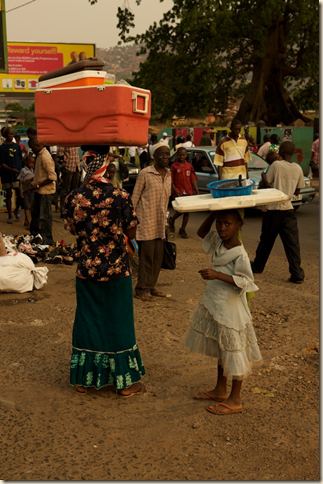
… and a few more on how to live it up with style.


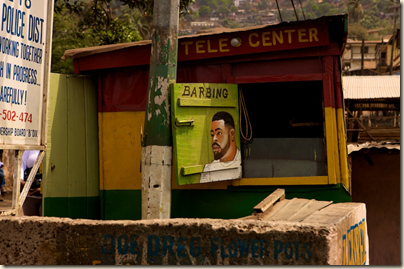
A sense of the color of commerce…

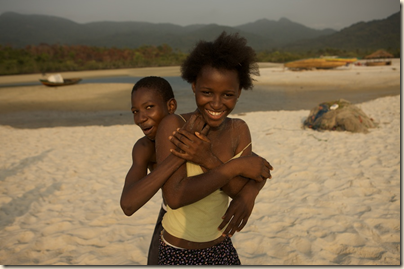
… of the looks of joy….


… and then, in the quieter moments, of a touch of sadness.

For more of Chuck’s stunning photos, see the full collection here.
Friday, May 29, 2009
Progress?
For better or worse, Freetown is now developing an upper crust scene typical of what you find in most African capital cities.
This occurred to me last night, as I sipped passable white wine and ate an artfully arranged plate of barracuda and mashed potato on the balcony of the Country Lodge, while a live jazz band played in the background. The tinkle of glasses and silverware mixed with the muted strains of Ella Fitzgerald, heat lightening brightened the sky over the coastal city far below, and a well-dressed crowd of the well-to-do – European, Lebanese, and African alike – chatted away.
This is not Freetown, I thought. This is Abidjan before the war. Or Dakar. Or Durban, for that matter.
But it is Freetown. It is now. It is again, because certainly Freetown had these kinds of places before the war.
Maybe tonight I’ll flash back to 2006 and seek out one of my old haunts, like PB’s restaurant on the side of Spur Road, separated from the traffic by a woven thatch screen. Burgers and pumping hip-hop. Pools of florescent light and vast stretches of darkness. The occasional smell of garbage or sewage. Raw and real.
Or maybe not. The jazz band is playing again tonight, at the Aqua Club, a members-only boating and sports club. Sunset cocktails by the sea.
Wednesday, May 27, 2009
Hierarchy of Professions
A police officer smiled through my passenger-side window as I crawled through traffic at the Eastern Police clock tower yesterday.
“Don’t you want to hire me to be your driver?” he said. He wasn’t kidding.
I looked at his name tag.
Sergeant.
Thursday, May 14, 2009
Stories I Like to Tell Part II – My Friendly Airport Security Lady
This is the second installment of Stories I Like to Tell About Sierra Leone. (Also check out the first one, about my friendly corrupt policemen.) If you are a blood relative, close friend, or have bought me a drink anytime over the last year, you’ve probably heard this story already. Sorry.
If, however, you are one of the 3 people who read this blog despite having no personal obligation to do so, read on!
To preface the story, I must describe a bit about Lungi Airport, Sierra Leone’s national airport and gateway for the small number of tourists the country has begun to attract, thanks to – as Tony Blair wrote after a recent visit – its “unspoilt beaches, beautiful tropical islands, world-class fishing and diving, and a rich cultural and historical legacy.”
Infamous for the astonishingly bad urban planning which located it across a large body of water from the capital city, Lungi is also notable for being the approximate size of a postage stamp. One runway, bordered by broken-down planes and a debris-strewn grassy plain, leads to an unimpressive two-story building with gap-toothed yellow-and-black letters spelling out Freetown 
Lungi has a few other characteristics worth noting.
The duty-free shop (the size of a NYC newsstand) sells a remarkably good selection of single malt whiskey at remarkably good prices. Or so I’m told.
The only other shop (the size of a NYC phone booth) sells candy bars and small canisters of Pringles for criminally high prices. This I know from experience, from trying to buy last-minute provisions for an empty stomach before a long flight.
An historical “landmark,” of sorts, is the porter who has been working at Lungi Airport since before Sierra Leone’s independence in 1961. He remembers military dictatorships, fledgling democratic regimes, and a war. He remembers colonial governors, tourists, diamond miners, journalists, peacekeepers, development workers – an endless parade of light-skinned visitors. He now stands about 4’11’’ – my grandfather’s height – and wears his brown uniform pants pulled up to that old man waistline, just below the armpits. He has a cataract in one eye, an impish smile, and a questionable command of the English language. He is far, far too old to tote bags.
“How old are you?” I ask him one day in Krio. He looks perplexed, embarrassed, and I immediately regret the question. He probably has no idea. I smile kindly in apology, and he tells me he put in his request for retirement this year. “They said no,” he said. “I have to keep working for a bit longer.” I was dumbfounded.
This porter is perhaps my new favorite Lungi story to tell. But before he came into my life, I used to wax lyrical about the thoroughness and professionalism of Sierra Leone’s airport security workers.
Now, security at Lungi is profoundly questionable at the best of times. There is no metal detector, no x-ray scanner, no narcotics-trained bloodhounds. Security consists of a cursory search (repeated three times but never involving more than a superficial rifling) of all luggage, and a physical pat-down to check for weapons or contraband.
First problem: it would be profoundly difficult for this process to uncover any but the most blatantly obvious breaches of law or security. When someone opens my backpack zipper, peers inside, and then zips it closed again, they’re apt to miss anything smaller than an AK-47. As proof, I can tell you that I have on several occasions brought 1.5-liter bottles of water through security in my carry-on backpack without detection. (Purely accidentally, of course – I have the utmost respect for the “put your 3-oz facial moisturizer in a plastic baggie and we’re all safe” rule, and would never try to smuggle extra drinking water on board.) In case you’re not clear, a 1.5-liter bottle of water is quite large. Almost the size of a big jug of Coke. If they can’t find that, how exactly will they find hidden narcotics or diamonds?
Second problem: it is tremendously easy to bypass this procedure entirely. You don’t have to be much of a VIP or pull too many strings to find someone to walk you straight out onto the tarmac and on board the plane. If my businessmen friends can do this with one simple phone call because they’re late and want to catch their flight, a cocaine baron could clearly arrange something of the sort to facilitate his multi-million dollar cargo. And anyway, the grounds of the airport are totally open to the surrounding community, so pretty much anyone can wander in and out as he pleases.
But all these problems pale in comparison to what happens when the security officers themselves stop taking their job very seriously – or at all seriously.
Last year, I was accompanying my friend Amie’s 14-year-old daughter through the airport security. I was flying to London and she was heading to Philadelphia for the school holidays.
We walked through the non-functional metal detector and placed our bags on the counter. The one female security guard – always responsible for female searches – is a generally jovial woman, and we smiled and chatted with her as she did her cursory bag check. She teased my companion about having to wear an “unaccompanied minor” tag around her neck.
We then walked over to the pat down area, where the guard is meant to make up for the lack of a metal detector by doing a thorough pat-down.
Instead, the guard looked both of us up and down, in our slim jeans and fitted tank tops, and laughed.
“I can tell you’re not hiding anything,” she said. “I don’t need to search you.”
“No?” I asked.
“No.” She stepped towards me, arms outstretched. “I’ll just give you a hug instead.”
And she did. A big bear hug. And then one to my young companion. And then she sent us on our way.
Thursday, April 16, 2009

Subscribe to:
Posts (Atom)